Institut für Linguistik
Goethe-Universität Frankfurt


Willkommen
Willkommen am Institut für Linguistik! Auf dieser Seite finden Sie alle wichtigen Informationen, die das Institut betreffen.
Herzlich willkommen am Institut für Linguistik!
Wir begrüßen herzlich unsere neuen Studierenden im B.A. Linguistik und M.A. Linguistics, die zum Wintersemester 2026/27 ihr Studium begonnen haben!
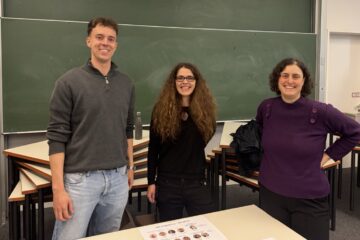
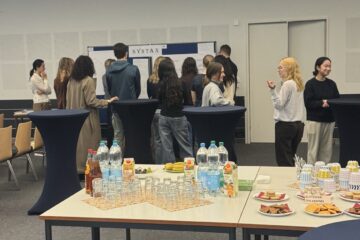
Zum Auftakt fand am 9. Oktober eine Begrüßungsveranstaltung im Open-Space-Format statt. An verschiedenen Ständen konnten die Studierenden die einzelnen Bereiche des Studiums kennenlernen, miteinander ins Gespräch kommen und erste Kontakte zu Lehrenden und Mitstudierenden knüpfen.
Wir wünschen allen einen schönen Studienstart und freuen uns auf das gemeinsame Semester!
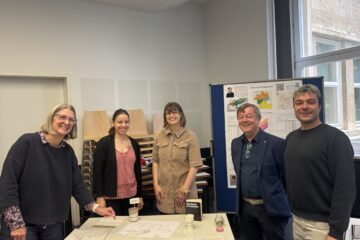

Am 19. September ist ViCom beim Frankfurt Science Festival auf dem Roßmarkt mit zwei interaktiven Stationen zur visuellen und multimodalen Kommunikation vertreten. Mehr erfahren.
|
Die Linguistic Owl-Stars beim Goethe-Lauf Sieben Mitglieder des Instituts für Linguistik gingen beim diesjährigen Goethe-Lauf als „Linguistic Owl-Stars“ an den Start. Mehr erfahren. |
 |
|
Proceedings der Sinn und Bedeutung (SuB) 30 Wir freuen uns sehr, bekannt geben zu können, dass die Proceedings der Sinn und Bedeutung (SuB) 30, die im September 2025 in Frankfurt stattfand, nun veröffentlicht sind! Der Band mit den großartigen Beiträgen, die auf der SuB30 präsentiert wurden, ist hier verfügbar. |
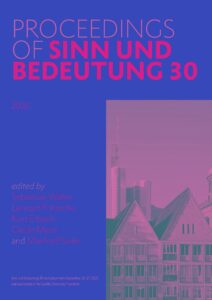
The cover was designed by Daniel Gutzmann and features a photograph by Alex Lowles (@alexlowlesphotography). |
„Questions? Answers! And more“ Workshop
Wir freuen uns, einen studentischen Workshop mit vier Vorträgen und fünf Postern im Rahmen des MA Seminars „Questions and Answers“ von Prof. Katharina Hartmann anzukündigen. Das Programm finden Sie hier.
Workshop Titel: Questions? Answers! And more
Datum: Montag, 06. Juli 2026
Zeit: 14:00h – 17:35h (s. t.)
Raum: IG 4.301 (linguistics room)
Corinna Langer und Anna Pressler verteidigen erfolgreich ihre Dissertationen
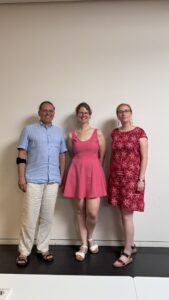 |
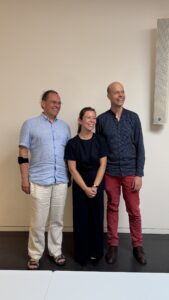
Am 26.06.2026 wurden zwei Dissertationen aus dem Phonologie-Lehrstuhl erfolgreich verteidigt. Corinna Langer verteidigte ihre Thesis mit dem Titel Focus and Prosody in Hungarian – investigating syntactically unmarked focus am Morgen und Anna Pressler verteidigte ihre Thesis zu Prosodic factors at the phrase level: the positioning of French adjectives am Nachmittag. Wir gratulieren beiden herzlich zu diesem Erfolg! Mehr lesen. |
 |
Sebastian Walter verteidigt erfolgreich seine Dissertation 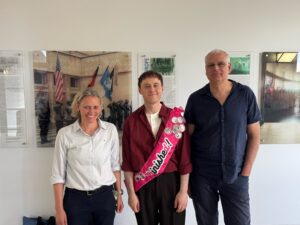
Proceedings der GLOW 47
Wir freuen uns, mitteilen zu können, dass die Proceedings der GLOW 47, die im März 2025 in Frankfurt stattfand, veröffentlicht wurden. Die aktuelle Ausgabe finden Sie hier.

Das Potenzialfeld Multimodal Communication
Im Januar 2026 ist das Potenzialfeld Multimodal Communication (Leitung: Cornelia Ebert, Frank Kügler) an der Goethe-Universität Frankfurt gestartet. Der Forschungsschwerpunkt zielt darauf ab, Wissenschaftler*innen aus der Linguistik, der Literatur- und Kulturwissenschaft, der Theater- und Performancestudien, der Film- und Medienwissenschaft, der Psychologie, der Neurokognition, der Musikwissenschaft sowie der Informatik zusammenzubringen.
Neuer DFG-Sonderforschungsbereich
Im Oktober 2025 startet an der Universität Tübingen der neue DFG-Sonderforschungsbereich Common Ground (SFB 1718). Wir freuen uns, dass das Institut für Linguistik mit dem Projekt Multimodalität, Ikonizität und der Common Ground: Zum Status von Lautsprache und Geste (PIs: Kathryn Barnes, Cornelia Ebert & Britta Stolterfoht) mit dabei ist.

Sinn und Bedeutung 30 (SuB30) 2025 in Frankfurt
Die 30. Ausgabe der Konferenz Sinn und Bedeutung (SuB30) findet vom 23. bis 27. September 2025 an der Goethe-Universität Frankfurt statt und wird von der Professur für Semantik organisiert.
Die Konferenz umfasst:
-
eine dreitägige Main Session (24.–26. September)
-
zwei eintägige Special Sessions:
Weitere Informationen unter: https://vicom.info/sub30/
Beste studentische Präsentation der MMSYM 2024 aus Frankfurt
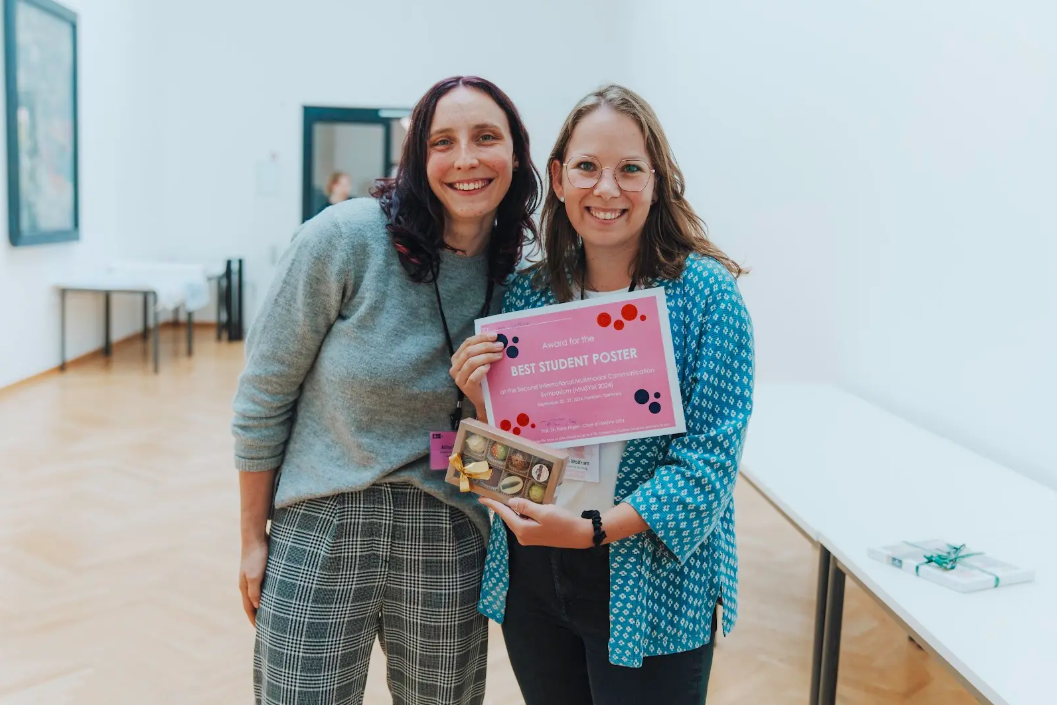
Die Mitarbeiterin und Doktorandin Alina Gregori, sowie Vera Wolfrum (Uni Würzburg) gewinnen beide auf der diesjährigen MMSYM den Preis für die beste studentische Präsentation.
Beste studentische Präsentation der Speech-Prosody 2024 aus Frankfurt
Die Mitarbeiterin und Doktorandin Anna Preßler gewinnt auf der diesjährigen Speech-Prosody-Konferenz den Preis für die beste studentische Präsentation.
Jacob- und Wilhelm-Grimm-Preise für internationale Germanistik an Ermenegildo Bidese
Ermenegildo Bidese (Universität Trento) hat 2021 im Fachbereich Neuere Philologien in Frankfurt habilitiert. 2024 erhält er den Jacob- und Wilhelm-Grimm-Preise für die internationale Germanistik des DAAD.
Ende der Seminare = Beginn der Hausarbeiten
Mit dem Ende der Vorlesungszeit beginnt die Arbeit an den Hausarbeiten. Wir bitten alle Studierende, die Hausarbeiten oder Abschlussarbeiten in der Linguistik schreiben, sich an unserem Leitfaden zu orientieren.
Wir feiern Katharina Hartmanns 60. Geburtstag
Während des Geburtstagsworkshops „Syntax in Focus – A workshop in honour of Katharina Hartmann’s 60th birthday“ überreichten wir am 12.01.2024 die Festschrift zu Ehren von Katharina: „To the left, to the right, and much in between“. Sie kann hier kostenlos als Ebook (PDF) heruntergeladen werden.

Wir beglückwünschen das Institut für Linguistik zum neu bewilligten Sonderforschungsbereich NegLaB
Ab April 2024 startet an der Goethe Uni der neue Sonderforschungsbereich der DFG „Negation in Language and Beyond“ (SFB 1629 NegLaB). Das Institut für Linguistik ist mit zahlreichen Projekten am SFB maßgeblich beteiligt.
MA-Student Farbod Eslami Khouzani erhält den diesjährigen DAAD-Preis
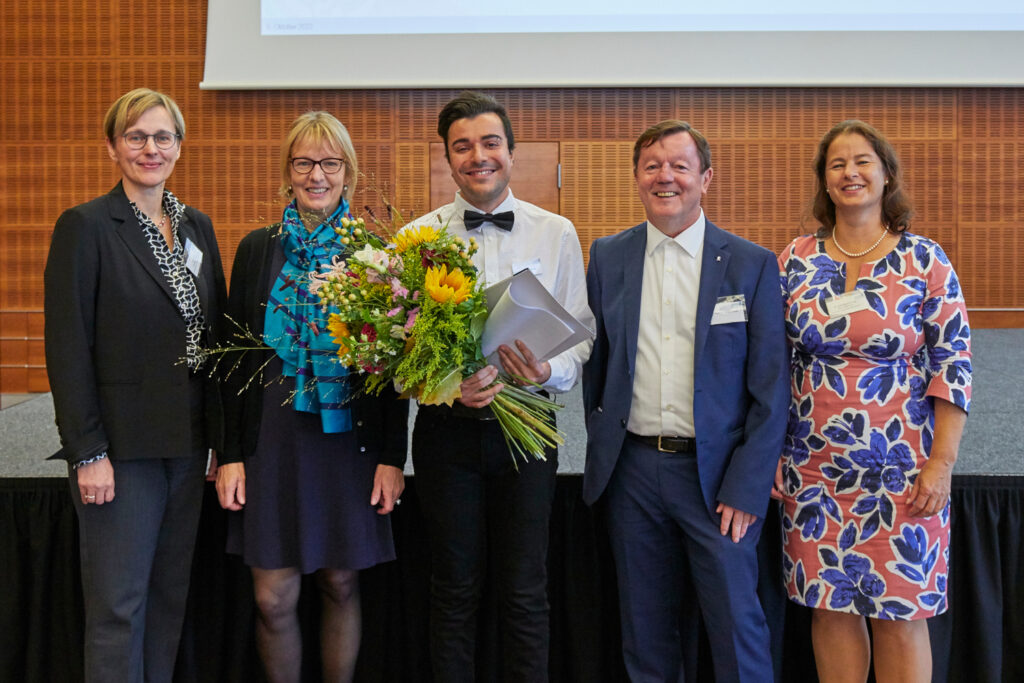
Der MA-Linguistik-Student Farbod Eslami Khouzani (Bild, Mitte) erhielt am 05.10.2023 den diesjährigen DAAD-Preis für internationale Studierende. Gewürdigt wurden seine hervorragenden Studienleistungen wie auch sein gesellschaftliches Engagement. Wir gratulieren herzlich! Mehr Informationen
Prof. Katharina Hartmann und Prof. Frank Kügler nominiert für die beste Promotionsbetreuung
Das Goethe Research Academy for Early Career Researchers (GRADE) verleiht jedes Jahr einen Preis für die beste Promotionsbetreuung. Dieses Jahr sind gleich zwei der Professor*innen aus der Linguistik nominiert: Prof. Frank Kügler und Prof. Katharina Hartmann. Mehr Informationen
Informationen für Studienanfänger*innen
- Dokumente, die nicht per E-Mail verschickt werden können, können in unserem “Hauspostfach 2” in der zentralen Poststelle (IG 257) hinterlegt werden.
- Wichtige Seiten mit aktuellen Informationen:
- Informationen zu Prüfungen (keine „Staatsexamen“):
https://www.pgks.de/
https://www.uni-frankfurt.de/73862497/ZPL___Aktuelles - Informationen fürs Lehramt (ABL):
https://lehrkraefteakademie.hessen.de/lehrerausbildung/pruefungsstellen/frankfurt-am-main/aktuelle-infos
- Informationen zu Prüfungen (keine „Staatsexamen“):
Studium
Das Institut für Linguistik der Goethe-Universität bietet in Zusammenarbeit mit dem Institut für England- und Amerikastudien, dem Institut für Psycholinguistik und Didaktik der deutschen Sprache und dem Institut für Romanische Sprachen und Literaturen zwei sprachwissenschaftliche Studiengänge an, den deutschsprachigen BA Linguistik sowie den englischsprachigen MA Linguistics, die beide ohne Nebenfach studiert werden. Außerdem bietet das Institut Veranstaltungen im Rahmen der Germanistik– und Lehramtsstudiengänge an.
Weiter Informationen:
- Ansprechpartner*innen
- Studienanfänger*innen
- Stundenpläne
- BA Linguistik
- MA Linguistics
- BA Germanistik
- Lehramtsstudium
- Erasmus-Programm (Studium im Ausland)
- Hinweise zu wissenschaftlichen Hausarbeiten
Forschung
Überblick zur Forschung am Institut
 |
|
 |

Das in Frankfurt am Fachbereich 10 (Neuere Philologien) angesiedelte Institut für Linguistik kann besondere Expertise in den Bereichen Sprachstruktur (Syntax und Phonologie), Bedeutung (Semantik und Pragmatik), Psycholinguistik (Spracherwerb, Sprachverarbeitung) und historische Linguistik vorweisen – diese Bereiche werden von international bekannten Forscherpersönlichkeiten vertreten. Darüber hinaus bestehen enge Kontakte und über einzelne Projekte hinausgehende Kooperationen mit den Sprachwissenschaftlern in den Einzelphilologien am Fachbereich (Anglistik und Romanistik), mit der Philosophie (Fachbereich 8), und dem Institut für empirische Sprachwissenschaft am Fachbereich 9 (Sprach- und Kulturwissenschaften).
Neben dem Institut für Linguistik wird Linguistik in Forschung und Lehre auch in anderen Instituten betrieben. Details dazu finden Sie hier:
- Institut für England- und Amerikastudien,
- Institut für Psycholinguistik und Didaktik der deutschen Sprache
- Institut für Romanische Sprachen und Literaturen
- Institut für Empirische Sprachwissenschaften
Das Potenzial der Frankfurter Linguistik liegt vor allem im Bereich der linguistischen Grundlagenforschung. Die rege Forschungstätigkeit wird in diversen Projekten gebündelt.
Institut
Am Institut für Linguistik finden sich die folgenden Professuren:
- Professur Historische Linguistik (Weiß)
- Professur Phonologie (Kügler)
- Professur Psycholinguistik (Bader)
- Professur Semantik (Ebert)
- Professur Syntax (Hartmann)
In der Lehre sind dem Institut für Linguistik die folgenden Professuren angeschlossen:
- Professur für die Didaktik der deutschen Sprache (Grimm, kooptiert)
- Professur für Philosophie (Fuhrmann, kooptiert)
- Professur für Spracherwerb (Schulz, kooptiert)
Hier kommen Sie zur Seite der Geschäftsführung.
Das in Frankfurt am Fachbereich 10 (Neuere Philologien) angesiedelte Institut für Linguistik kann besondere Expertise in den Bereichen Sprachstruktur (Syntax und Phonologie), Bedeutung (Semantik und Pragmatik), Psycholinguistik (Spracherwerb, Sprachverarbeitung) und historische Linguistik vorweisen – diese Bereiche werden von international bekannten Forscherpersönlichkeiten vertreten.
Darüber hinaus bestehen enge Kontakte und über einzelne Projekte hinausgehende Kooperationen mit den Sprachwissenschaftlern in den Einzelphilologien am Fachbereich (Anglistik und Romanistik), mit der Philosophie (Fachbereich 8), und dem Institut für empirische Sprachwissenschaft am Fachbereich 9 (Sprach- und Kulturwissenschaften).
Das Potenzial der Frankfurter Linguistik liegt vor allem im Bereich der linguistischen Grundlagenforschung. Die rege Forschungstätigkeit wird unter anderem in der DFG-Forschergruppe Relativsätze gebündelt.
Das Institut für Linguistik betreut die Studiengänge BA- und MA-Linguistik, und ist für die linguistische Ausbildung im BA-Germanistik und in den Lehramtsstudiengängen (Fach Deutsch) zuständig.
Talk by Giuliano Armenante (Potsdam) in the Semantics Colloquium
We are happy to announce a talk by Giuliano Armenante (Potsdam) in the Semantics Colloquium.
The talk will take place on campus in IG 4.301.
Zoom link: https://uni-frankfurt.zoom-x.de/j/62660316332?pwd=94KnkxFireEQFCWBGpi35ZwrClwoLa.1
Date: October 29, 2026
Time: 4 pm – 6 pm c.t.
Title: There is more than one way to X-mark: The lesson from West Africa
Abstract: Conditionals expressing remote possibilities are often morphologically distinguished from those expressing open possibilities through specialized “X-marking” morphology (von Fintel & Iatridou 2023). This morphology includes both repurposed fake past forms (as in English) and dedicated counterfactual markers (e.g. Hungarian -nA) (Iatridou 2000). Competing modal (Mackay 2019; Schulz 2014) and temporal analyses (Arregui 2009; Ippolito 2013) have been proposed for English fake past. Recent cross-linguistic work, however, reveals a more nuanced picture, suggesting that temporal and modal contributions to X-marking can be dissociated (M. Kaufmann & Todorović 2024; S. Kaufmann 2023; Mizuno 2023).
In this talk, I contribute to this debate by presenting novel data from three Kwa languages (Niger-Congo): one tensed language, Akan, and two tenseless languages, Ga and Ewe, all of which employ dedicated X-marking. I show that (i) dedicated X-marking contributes modal expansion of the conditional’s domain of quantification in all three languages (cf. S. Kaufmann 2023; Stalnaker 1975; von Fintel & Iatridou 2023); (ii) in Akan, past tense morphology shifts either the evaluation time or the reference time of the conditional, thereby retaining its temporal contribution; and (iii) in Ga and Ewe, X-marked conditionals exhibit greater, though distinct, degrees of semantic variation.
Building on these findings, I argue that X-marking is not a uniform semantic category, but may involve modal expansion, backward temporal displacement, or both. I further show that distinguishing these contributions offers a way to reconcile recent criticisms of strictly temporal analyses (von Fintel & Iatridou 2023) with those of modal analyses of past morphology (Ippolito & Mirrazi 2026).
Talk by Morgan Moyer (Barcelona) in the Semantics Colloquium
We are happy to announce a talk by Morgan Moyer (Barcelona) in the Semantics Colloquium.
The talk will take place on campus in IG 4.301.
Zoom link: https://uni-frankfurt.zoom-x.de/j/62660316332?pwd=94KnkxFireEQFCWBGpi35ZwrClwoLa.1
Date: October 22, 2026
Time: 4 pm – 6 pm c.t.
Title: Meaning Beyond Truth: A Psychosemantic Approach to Affective Meaning
Abstract:
How are different kinds of linguistic meaning represented and accessed in cognition? Research in semantics and pragmatics distinguishes truth-conditional content from presuppositions, conventional implicatures, and other kinds of non-at-issue meaning. Experimental pragmatics and psycholinguistics, meanwhile, investigates how linguistic information becomes available during comprehension, how pragmatic inferences unfold over time, and how semantic features organize conceptual representations. Yet the relationship between these linguistic distinctions and the cognitive status of the content they characterize remains poorly understood.
This talk brings together two strands of experimental research to investigate this relationship. The first examines the cognitive prominence of affective valence relative to truth-conditional conceptual features. Using speeded categorization and similarity judgments, I investigate whether affective information is especially accessible and whether it plays a distinctive role in organizing conceptual representations. The second examines evaluative inferences associated with „thick“ moral adjectives, such as „generous“ and „egotistical“, using diagnostics of contradiction, similarity, at-issueness, and projection to characterize the relationship between evaluative and descriptive content.
I connect these research programs through the problem of linking theoretical distinctions to experimental measures. Research on pragmatic inferences highlights the assumptions involved in interpreting behavioral responses as evidence for particular kinds of meaning (Degen & Goodman 2014; Jasbi, Waldon & Degen 2019). Meanwhile, Abrusán’s (2011) account of presupposition motivates a connection between pragmatic status and the allocation of attention. Together, these approaches invite us to question whether distinctions in linguistic meaning correspond to differences in cognitive accessibility, representational organization, or how information is integrated in interpretation.
I ask whether the cognitive prominence of affective information relates to the pragmatic behavior of evaluative content, or whether accessibility, conceptual similarity, and pragmatic status constitute distinct dimensions of meaning. By bringing these questions into dialogue, I aim to develop an empirically grounded account of how linguistic meaning distinctions relate to the representations and processes through which language interfaces with cognition.
Lennart Fritzsche and Sebastian Walter present at Linguistic Evidence 2026 in Mannheim
The Semantics team was represented with a talk and a poster at Linguistic Evidence 2026, held at the Leibniz Institute for the German Language (IDS) in Mannheim on October 15–16, 2026.
Sebastian Walter gave a talk titled „Can depictive meaning generate alternatives? Evidence from co-speech and pro-speech gestures“. Lennart Fritzsche presented a poster titled „Commitment modifiers in German polar questions“.
We are very happy to see the Semantics team represented with two contributions at Linguistic Evidence 2026.
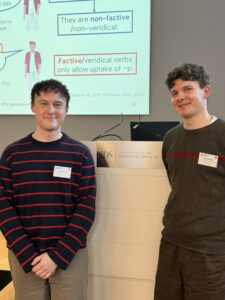
Workshop “At-issueness and Commitment: Interfaces and Interactions” held at Goethe University Frankfurt
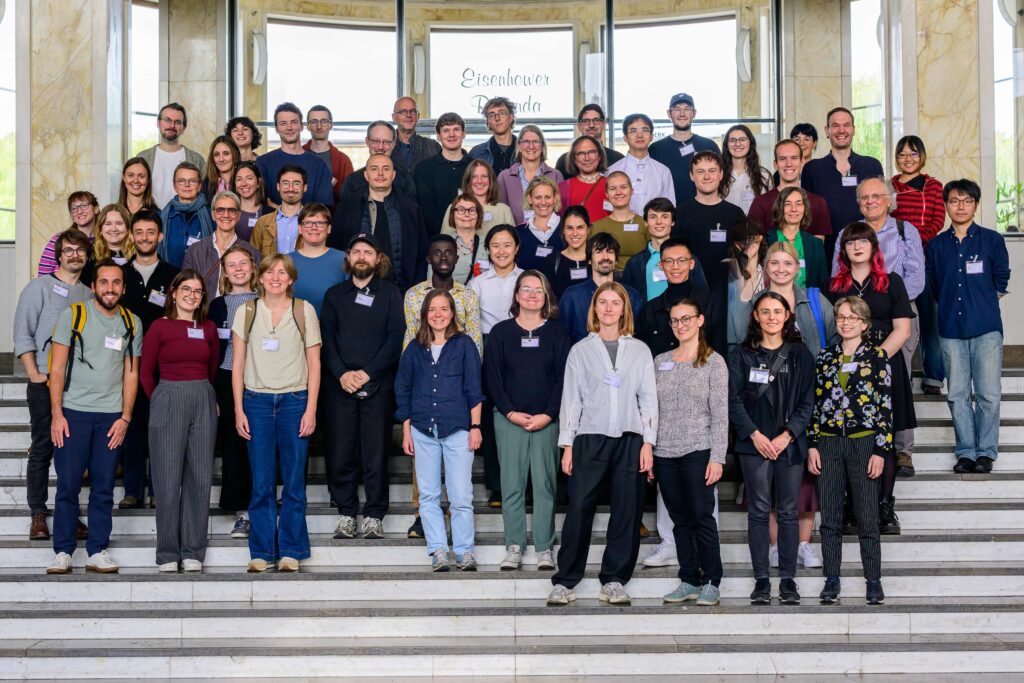
On September 21–22, 2026, the workshop At-issueness and Commitment: Interfaces and Interactions took place at Goethe University Frankfurt. The workshop was organized as part of CRC 1718 Common Ground, funded by the German Research Foundation (DFG), and hosted by Project A4 Multimodality, Iconicity and the Common Ground: The Status of Speech and Gesture.
The workshop brought together researchers from semantics, pragmatics, psycholinguistics, philosophy of language, and related fields to discuss the relationship between at-issueness and commitment. Both notions play a central role in theories of meaning and discourse, but their relationship remains far from settled. Does at-issue content generally come with stronger speaker commitment? Can at-issueness and commitment come apart? Or should one of the notions ultimately be understood in terms of the other? These questions provided a common thread throughout the two days and connected a wide range of theoretical and empirical work.
The program featured invited talks by Anna Kocher (KU Eichstätt-Ingolstadt), Martina Faller (University of Manchester), and Corien Bary (Radboud University Nijmegen), alongside eleven contributed talks and two poster sessions with 21 posters. We were also very pleased to welcome CRC Mercator Fellows Bart Geurts and Manfred Krifka, both of whom contributed talks to the program.
The contributions reflected the breadth of the topic, covering phenomena ranging from presuppositions, appositives, evidentials, and adverbials to questions, irony, metaphor, gestures, and pictorial communication. The program brought together formal semantic and pragmatic analyses with experimental work, corpus studies, commitment logic, facial EMG, and work with language models, and included data from a wide range of languages.
With around 70 registered participants, the workshop grew far beyond what we had initially expected. More importantly, the two days were marked by lively discussions across theoretical and methodological traditions, both during the talks and poster sessions and beyond the scheduled program. The range of perspectives made clear how much there still is to understand about the relationship between at-issueness, commitment, and the common ground, while also showing how productive it can be to bring these research strands into direct conversation.
We would like to thank all speakers, poster presenters, and participants for making the workshop such a stimulating and enjoyable event. We are especially grateful to our invited speakers and to everyone who traveled to Frankfurt to contribute to the discussion.
The workshop was organized by Kathryn Barnes, Cornelia Ebert, Lennart Fritzsche, Ramona Saile, and Britta Stolterfoht as part of CRC 1718 “Common Ground.” We gratefully acknowledge support from the Deutsche Forschungsgemeinschaft (DFG, German Research Foundation), SFB 1718, project number 538184825.
Cornelia Ebert and Sebastian Walter present at the 6th Experimental Pragmatics in Italy (XPrag.it)
The Semantics team was represented with two posters at the 6th Experimental Pragmatics in Italy (XPrag.it 6), held in Genoa, Italy.
Cornelia Ebert and Sebastian Walter, together with Daniel Teich and Stefan Hinterwimmer, presented a poster titled „Event kind vs. event token interpretations of iconic gestures in the VP domain“. Sebastian Walter, together with Lyn Tieu, Selina Zheng and Natalia Liu, presented a second poster titled „At-issue and non-at-issue contributions of emoji: Evidence from contrastive inferences“.
We are very happy to see the Semantics team represented with two contributions at XPrag.it 6.
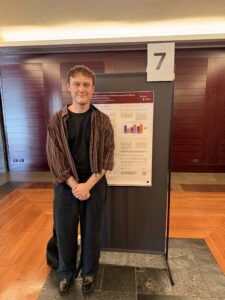
Sebastian Walter presenting the poster “At-issue and non-at-issue contributions of emoji: Evidence from contrastive inferences”.
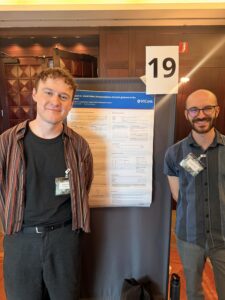
Daniel Teich and Sebastian Walter presenting the poster “Event kind vs. event token interpretations of iconic gestures in the VP domain”.